

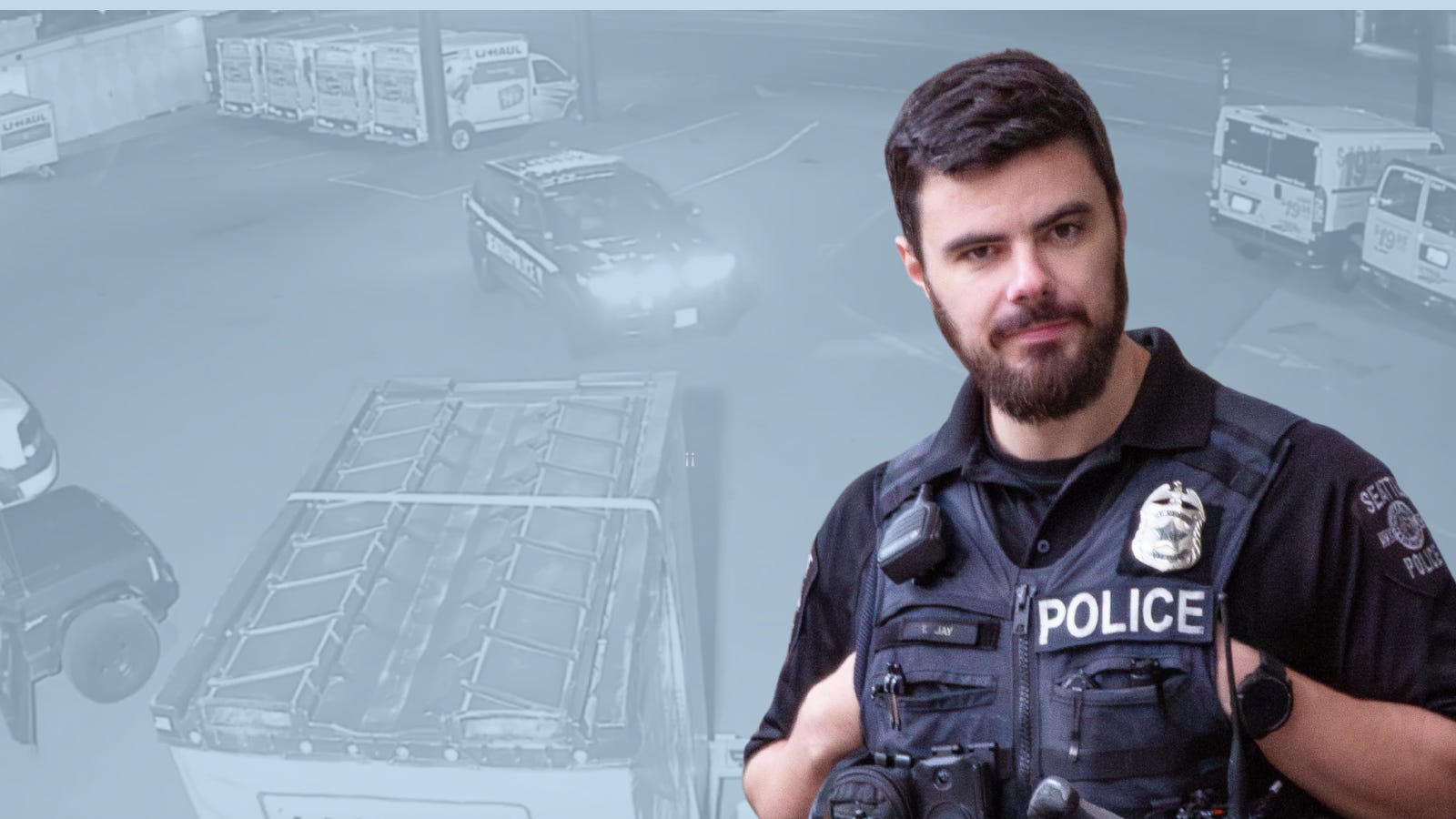
Internal investigators found persuasive evidence that Seattle police Officer Tanner Jay lied during a disciplinary investigation, but the Office of Police Accountability did not issue sustained findings, according to a report released last week. This is the second time the OPA has chosen not to sustain dishonesty allegations against Jay despite overwhelming proof that he lied.
The penalty for dishonesty is presumed to be termination under the terms of the Seattle Police Officers Guild contract.
Last spring, the manager of a U-Haul location filed a complaint with the OPA, alleging that Jay did not stop two people who were seen on camera siphoning gas from a company truck. The location was closed, but the manager was monitoring the security feeds remotely and called the police.
Jay pulled into the lot shortly after the two people put the gas can into a red Jeep and talked with them for less than 10 seconds before waving them out of the parking lot. He did not activate his body-worn or in-car video, document the contact in a report, or update the call notes in his computer-aided dispatch system.
In his interview, Jay told OPA that he was unaware of the theft call at that location. He claimed he was making a “social contact” in the parking lot because the U-haul site was frequently targeted for theft.
He said that he had not seen the call information on his computer notifying him of the theft at that location. However, the system log showed that he double-clicked the call on his CAD system and clicked “Get Call” to download the call information before heading directly to the call location.
Jay said that he did not learn about the theft until he contacted the U-Haul manager later by phone, and that he did not detain the pair because he didn’t observe anything “abnormal.” The CAD updates contained a detailed description of the suspects and their vehicle.
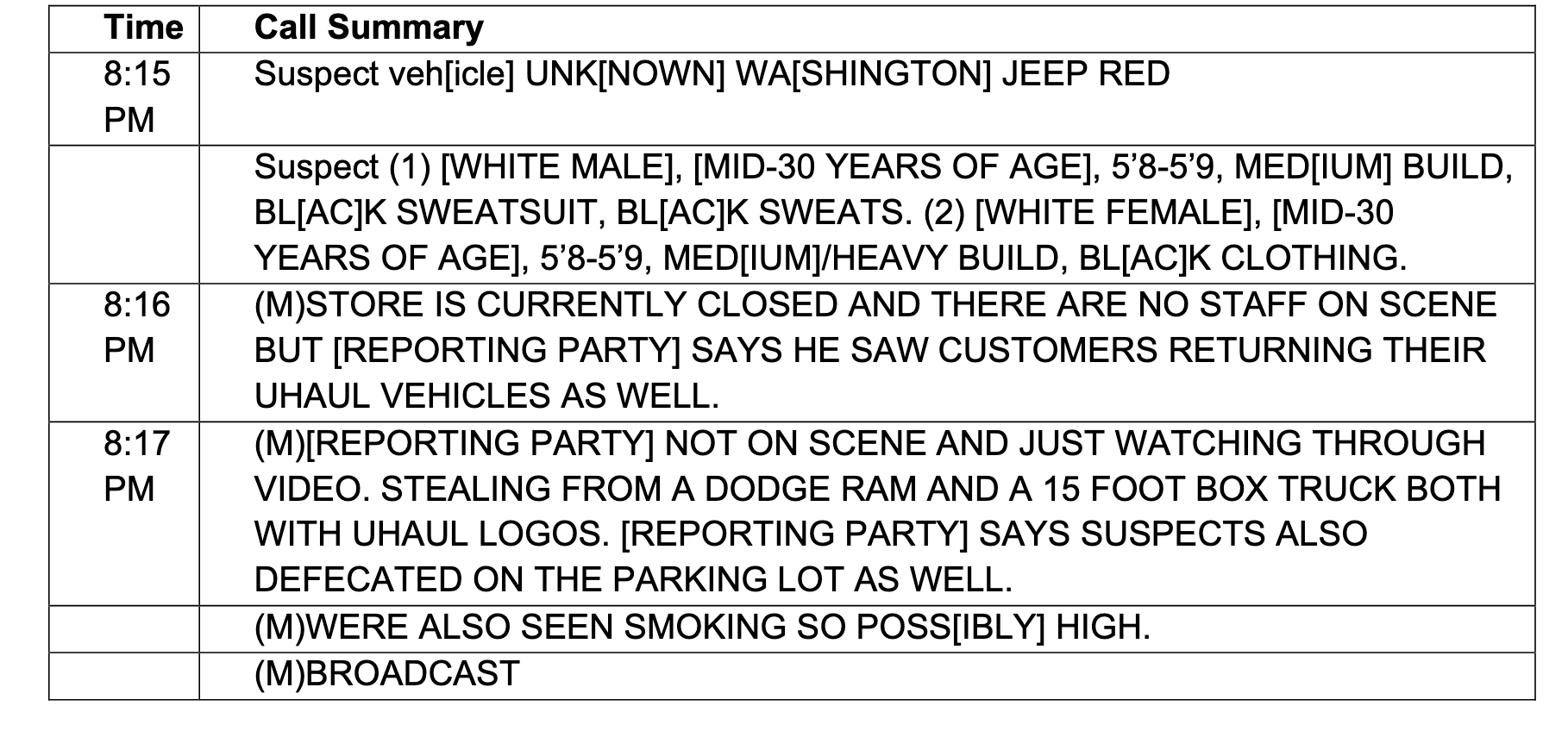
When asked if he read the updates, Jay said that he did not remember but that he does so “most of the time.”
The OPA also quizzed Jay over the license plates on the suspect’s Jeep— or lack thereof. The plates were missing on the front and back, giving him reasonable suspicion to detain them for a second crime. He acknowledged that missing plates usually mean the car was stolen.
Though he claimed that he recalled almost nothing else about the call, he somehow remembered that the Jeep had temporary tags, a trip permit, or “something” that made him decide that nothing was amiss. The security video did not show any of these things.
Initially, the OPA found Jay was “intentionally and materially dishonest.” The evidence was cut and dry. He claimed to be unaware that there was a theft call at the location, but he drove directly to it. Jay would’ve known the basic details of the call after clicking “Get Call” and likely would have read the updates because he said that he does “most of the time.”
But after three disciplinary hearings with commanders and police guild reps, the OPA walked back its findings. While the agency found there was strong evidence showing that he knew about the nature of the call and made a false statement to internal investigators, the OPA ostensibly could not prove he was intentionally dishonest.
The incident occurred two and a half months before the interview with internal investigators, the OPA argued, and the call was “fairly routine,” so the passage of time could’ve affected his recollection. Also, there was no report or body-worn camera footage to refresh his memory. The finding was revised to “inconclusive.”
In an earlier case involving Jay, the OPA found solid evidence that he faked a conversation with a reporting party to cover for reckless driving. When a man flagged Jay down in Eastlake to tell him to slow down, Jay told him that he was speeding to a call about a “man with a gun.”
Cop faked conversation with witness to cover for reckless driving

Officer Tanner Jay was reprimanded for driving more than twice the speed limit without emergency equipment and being rude to a man who asked him to slow down, according to a recently released disciplinary report. The Office of Police Accountability also found evidence that Jay may have lied about his reasons for speeding— even going so far as to stage a…
Afterward, he called the reporting party back and had him rehash details about the burglary call that he already knew. After the man hung up, Jay continued talking as if he was still on the line and asked him to confirm that the man had a gun. The man’s voice was clearly audible on Jay’s body-worn camera until the last segment of the call. Incredibly, the OPA issued “inconclusive” findings and sustained only lesser allegations.
In the U-Haul case, the OPA sustained allegations that Jay did not take appropriate action, search for evidence, write a report, activate his body-worn camera, or act professionally. He was suspended for three days.