

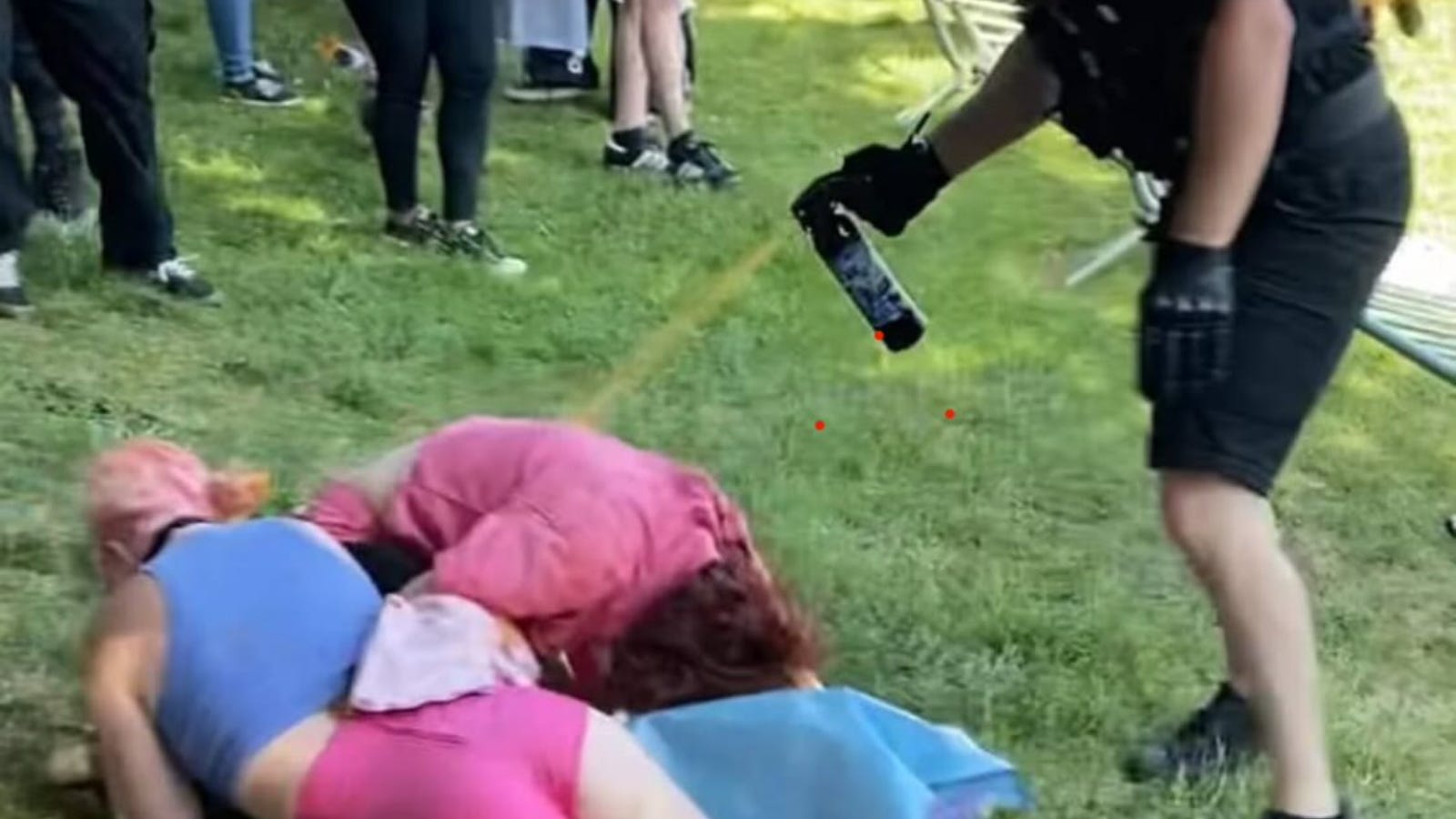
The image of Officer Brian Muoio standing over two protesters, pepper-spraying them as they huddled on the ground, became a symbol of the violent police response to a counterdemonstration against an anti-trans concert in Cal Anderson Park last May. It was attached to or referenced in dozens of complaints to the Office of Police Accountability about the department’s mishandling of the event.
In its 28-page report on the incident, the OPA claimed that the picture doesn’t tell the whole story. It’s said that a picture is worth a thousand words — the OPA spent nearly 8,000 attempting to explain away Muoio’s actions and those of four other officers named in the complaint.
Of course, the agency had to rely on that picture along with Muoio’s force reports and snippets of the incident captured on other officers’ bodyworn cameras because Muoio didn’t activate his camera, which was the only sustained finding.
Community Response
Earlier that afternoon, members of the Community Response Group, the anti-protest unit Muoio belongs to, had ridden into the park on bicycles and made several arrests after someone released a balloon belonging to the fundamentalist group on the edge of the concert. Officers lost sight of the original suspects and started detaining or arresting anyone wearing black bloc.
Later, they set up a short aluminum barrier between the counterprotesters and the concert. CRG officers went back into the park to arrest a woman who had knocked down the fence. According to Muoio’s force report, when he grabbed the woman’s arm, she “twisted” and tried to escape. Another woman came up and threw a paper sign in his face, Muoio claimed. When she tried to grab him, he pushed and pepper-sprayed her, then she fell.
Muoio explained the image of him pepper-spraying the two on the ground. He claimed that both of them were “clawing and swatting” at him and “advancing” on him while they were on their knees, so he pepper-sprayed them at the “eyebrow line,” but they turned away at the last second and “turtled.”
Describing that moment in the report, the OPA wrote that the two “extended their arms,” but never explicitly states that the video corroborates Muoio’s claim that they were swatting at him. There is a relatively clear shot taken from another officer behind Muoio.
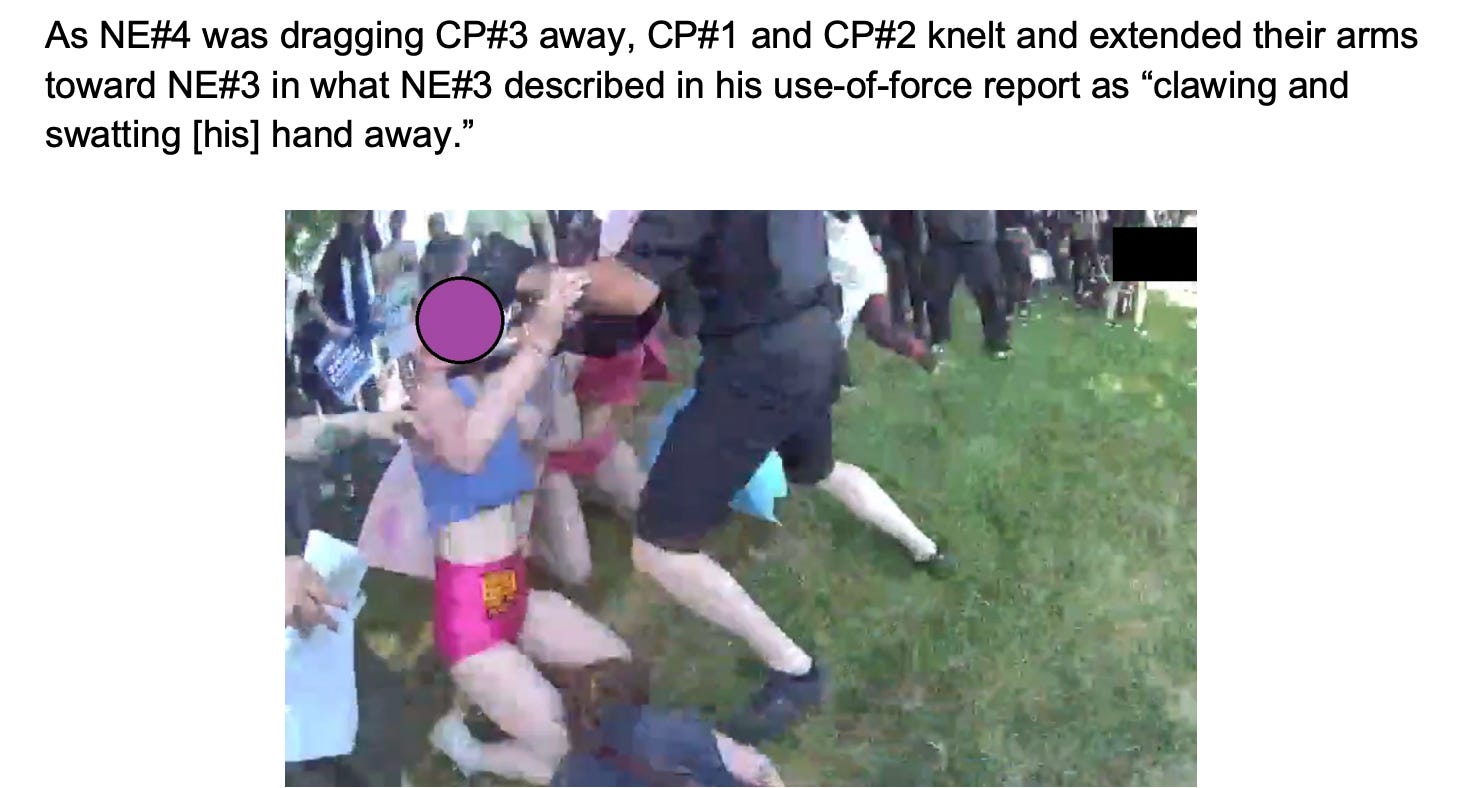
Notably, neither of the two protesters was ever charged with assaulting an officer, and their misdemeanor obstruction charges were never prosecuted. Explaining its decision not to sustain excessive force allegations, the OPA wrote that the “picture did not capture the entire altercation and the rapid speed at which the altercation unfolded.”
Shot in the Back
In another incident shortly after this, a man threw an umbrella at the feet of CRG Lieutenant Matthew Didier, and officers arrested him. Another man walked up to within 20 feet of where they had the man pinned down. Officer Matthew Clark, armed with a pepper-ball gun, locked eyes with him. The man turned away and started running, and Clark shot him in the back five times.
In his OPA interview, Clark referred to “force science,” a pseudoscience used primarily to justify deadly shootings. Its founder, William Lewinski, often testifies in court cases, explaining that there’s a “reactionary gap.” In other words, when an officer determines that a threat exists and decides to fire, they’re effectively locked in and can’t stop in response to split-second changes in the situation.
Clark paraphrased this: “I made a decision that that person was a threat. And as I raised my pepperball and was deploying the pepperball, that person changed their mind and turned around and ran away.”
However, the video shows that Clark did not raise his gun until the man’s back was already turned, and Clark states in his force report that he aimed for the back. It’s also noteworthy that Clark never described the man as doing anything threatening — only that he was 20 feet away, which is “a distance sufficient to throw objects at [the arresting officers].“
Apparently, these explanations were enough for the OPA. The so-called accountability agency wrote that the man’s “unexpected decision to flee during that one-second window did not render [Clark] pepperball deployments excessive.” The OPA even cited his turning around as evidence that he was probably up to no good: “[He] was the only counter protester who fled as [Clark] quickly approached, suggesting he may have had criminal intent.”
Clark was given retraining, though, for failing to issue a verbal warning before he fired.