

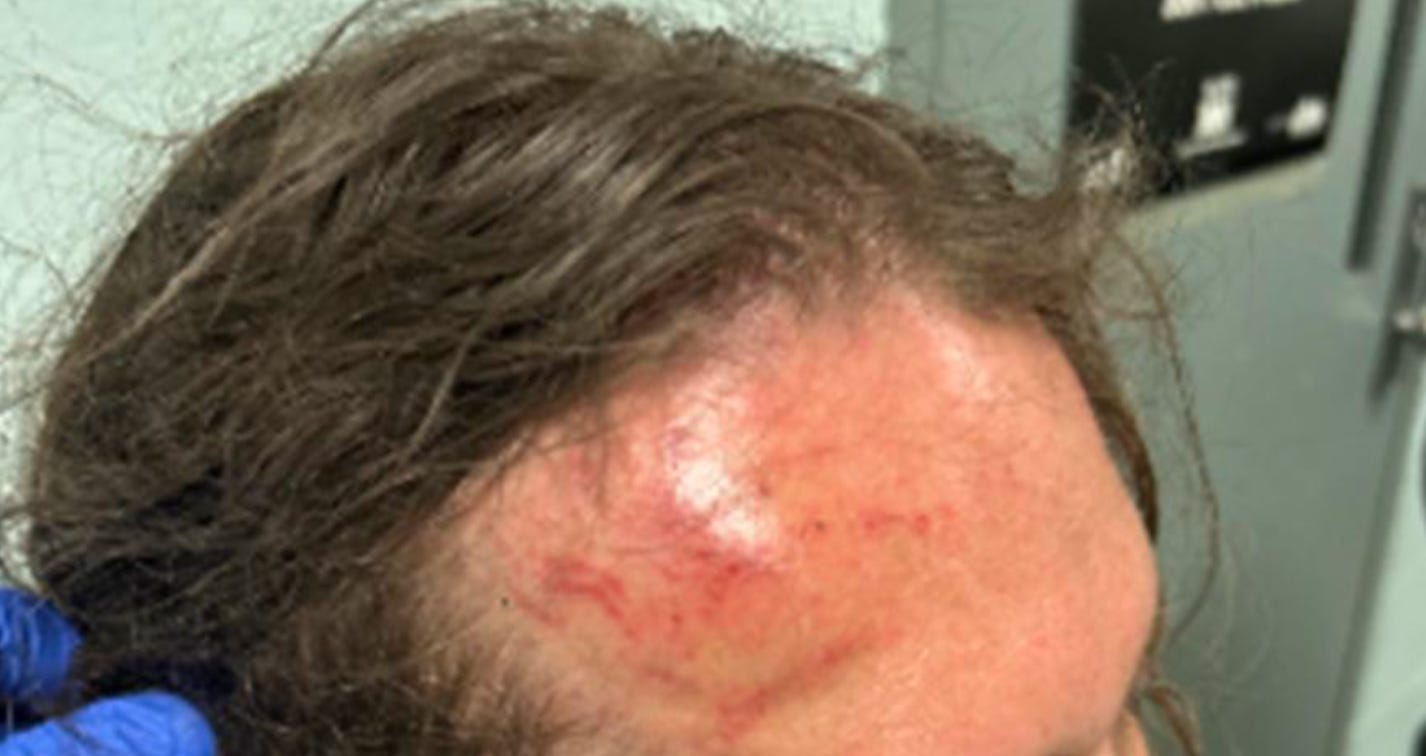
How many punches to the head are too many? That’s the question that the Office of Police Accountability tried to answer in its investigation of a violent incident at Cal Anderson Park last May, when Seattle Police Sergeant David Adams rushed a protester, threw him to the ground, and punched him in the head over and over.
The OPA initially found that the first four punches were acceptable, while the last four were not. However, the so-called accountability agency had a come-to-Jesus moment after talking to Adams’ chain of command.
The incident occurred during SPD’s mass arrest of trans and queer people protesting a fundamentalist concert in the park themed “Don’t Mess With Our Kids” on May 24. Adams was part of SPD’s anti-protest unit, which deployed into the park to arrest two people for misdemeanor property destruction — namely, releasing some balloons and tampering with a bubble machine.
New May 24 footage shows sergeant punching protester repeatedly

Newly released video of arrests at the Mayday USA concert in Cal Anderson Park earlier this year shows a Seattle police sergeant taking a counterdemonstrator to the ground and punching him multiple times. The sergeant’s body-worn video also undermines the basis for the initial arrest.
This escalated the crowd, and when officers lost sight of the two, they began arresting everyone wearing black bloc in a chaotic melee. Bodycam footage shows Adams run up behind officers making arrests, then trip over a bike. Adams spotted the protester standing about 10 to 15 feet away and charged at him (See our previous reporting for a more complete description of the incident).
No obstruction, no assault, no weapon
The OPA found that Adams had probable cause to arrest the man for obstruction at this point, but we dispute this finding. Disobeying an order is a key component of an obstruction charge. Adams told the OPA that the man “continued approaching despite being ordered to stay back.” The video contradicts this.
While the audio on Adams’ camera was off shortly before the arrest, an officer was standing near him. Nothing resembling an order can be heard on his bodycam. The man did not physically interfere with the arrest. He was merely standing there giving the double middle finger. There were many others in the vicinity who were as close or closer to the arrest than he was.
When Adams ran up on the man, he put his hands up defensively. Adams claimed that the man was swinging at him or trying to grab his helmet. That raised the offense from a questionable obstruction charge to an equally dubious felony assault, and the justifications for all of Adams’ subsequent actions flow from that. In other words, it wouldn’t be proportionate to punch someone in the face over a misdemeanor or physical resistance, but it would be acceptable for a felony assault.
'Go in heavy'—SPD's violent May sortie into Cal Anderson started with a balloon

After the Seattle police rolled into Cal Anderson Park on bikes and arrested 23 people counterprotesting a fundamentalist concert in May, there were lots of wild stories about how it all started. One of the more fanciful claims still circulating was that “antifa” chucked water balloons filled with urine into the crowd. As it turns out, a balloon
Adams said that he punched the man to “loosen” him up so he could get his hands behind his back, but that’s not “necessary” force — that’s expedient. Justifying the punches, Adams explained that the man “could have accessed a weapon during the altercation,” but his hands were visible the entire time.
After the first four punches, the man covered his head with both hands, and Adams punched him four more times. In its first draft, OPA found that the last four were unjustified. By this point, the level of resistance had dropped, another officer was there to help, and the situation had stabilized so that there was less urgency to get him in handcuffs, the OPA argued.
However, the OPA walked its findings back after Adams’ chain of command maintained that he was still an active threat at that point. In particular, they noted that Adams dropped his pepper-spray can, and it was underneath the protester. They painted an implausible scenario that the man, who was prone with two officers grabbing each arm, would somehow be able to grab it, turn over, and spray them in the face.
The OPA found this “compelling,” and amended its findings.
Sloppy or Malicious
Lastly, the OPA determined that another allegation, which was captured on camera, did not happen at all and was not captured on camera. This occurred shortly after the arrest, when the man was cuffed on the ground. Adams ordered the man to turn over on his belly, and he cursed at Adams.
Adams is shown on his bodycam going up to the man and pushing the handcuffs up his back until the man screams in pain. Any actions that cause pain are considered reportable force, and force on handcuffed prisoners is prohibited except in extreme circumstances.
The report reads:
This allegation is unfounded. NE#1 did not twist CP#1’s handcuffs or press them into CP#1’s back as alleged. Rather, BWV showed CP#1 unwilling to stand or walk, requiring NE#1 and WO#1 to use de minimis force3 to raise CP#1. NE#1 pulled the back of CP#1’s shirt upward, causing CP#1 to rise, and then escorted him away by holding onto his arm. Overall, NE#1 did not use any reportable force while CP#1 was handcuffed
This sentence — “NE#1 pulled the back of CP#1’s shirt upward, causing CP#1 to rise, and then escorted him away by holding onto his arm” — is apparently a reference to a segment of the video that takes place three minutes after the prohibited use of force:
The OPA investigator, Det. Travis Jordon, either did not watch the entire video or he maliciously cherry-picked the segment to exonerate his coworker and fellow police guild member. The Office of the Inspector General approved this allegation for expedited review, meaning the OPA could issue findings based on bodycam footage alone.
It reflects a disturbing trend in the so-called police accountability system. Fewer cases are being fully investigated. In 2022, 37 percent of misconduct underwent a full investigation. By 2025, that proportion had fallen to 23 percent, with growing numbers of cases being classified as “expedited,” “supervisor action,” and “contact log.”
Hey, before you go…
DivestSPD is your only source for critical police coverage in the Puget Sound. From filing public records to reading hundred-page reports, we’re putting in the hours to bring you weekly exclusive stories about cops brutalizing the public, committing crimes, and violating civil rights.
We also get all of our funding from ordinary people like you. If you think this work is valuable and you want it to continue, join our Ko-Fi community today. Tiers start at just $5 a month.