

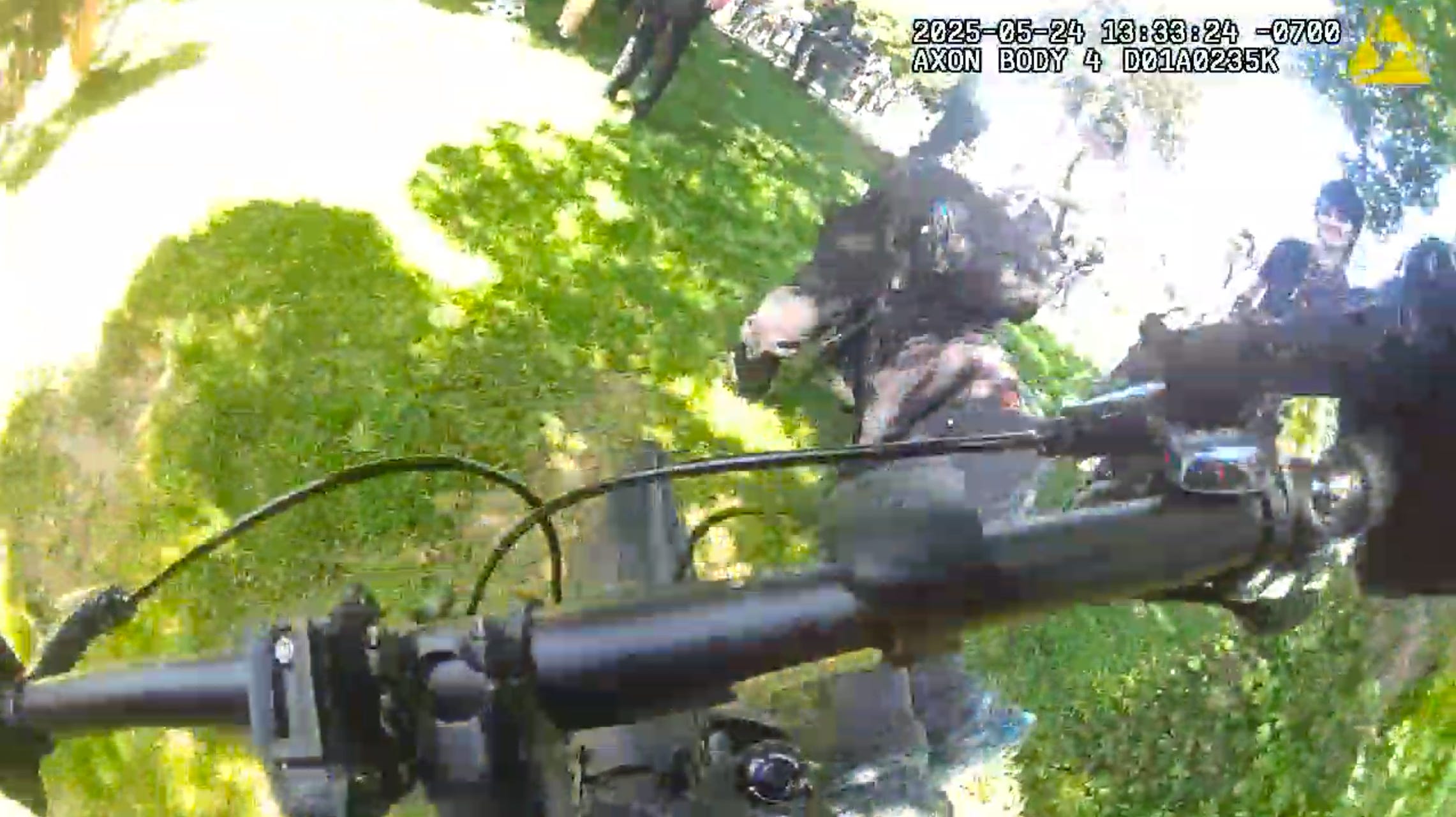
Seattle police Officer Brian Muoio told internal investigators that he did not recall crashing into a protester with his bike last May, according to a recently released disciplinary report. While biking into a crowd of counterprotesters, Muoio struck a man dressed in “black bloc” head-on, sending him flying several feet to the ground.
Muoio was given a written reprimand, the second-lowest discipline, for operating his bicycle unsafely. This was the only discipline issued to any officer involved in the Seattle Police Department’s violent response to a counterprotest against an anti-trans concert at Cal Anderson Park on May 24.
Last week, the Office of the Inspector General issued its final report on the debacle, which faulted department command, including Lt. Matthew Didier, for its poor decision-making. However, except for Officer Muoio, no officers so far have been disciplined for punching, pepper-spraying, or pushing protesters.
In its report on Muoio’s bike crash, the Office of Police Accountability said, in so many words, that Muoio was lying. Muoio claimed that he “unintentionally” brushed up against protesters with his handlebars, but that he didn’t remember striking the man and knocking him down until he reviewed his body-worn video.
The OPA wrote that this claim was “highly questionable,” noting that “the force of the impact momentarily halted [Muoio] before he could resume pedaling.” The report continued, “Even if OPA were to accept [Muoio]’s claim as sincere, this would still be concerning. If true, it would call into question [Muoio]’s ability to recognize instances where he had struck someone.”
Here, the OPA presented a well-founded argument that Muoio is being dishonest, yet chose to take no action. Normally, when an officer lies in an OPA interview, the agency opens a new investigation, as it did in the cases of Sgt. Michelle McRae and Sgt. Jamin Dobson, or tacks on new allegations to the current one.
Telling investigators that you “don’t recall” something is a tried-and-true tactic police officers use to avoid being caught in a lie. It was effective in a recent case involving Officer Tanner Jay. In that case, the OPA initially sustained dishonesty allegations, a fireable offense, but walked its findings back after three disciplinary hearings because it supposedly could not prove the allegations met the elevated standard of proof under the police guild contract.
The OPA likely knew it could not meet that standard again, so it did not bother going through the motions. There was an impasse on this very issue in the negotiations on the last police guild contract, which was rushed through in October without resolving the dispute, so cops can continue to lie and commit other serious misconduct with virtual impunity until that’s addressed, if ever, in interest arbitration.